At the World Economic Forum in Davos, political leaders and technology executives made the case for closer government–industry collaboration to expand AI infrastructure, develop sovereign models and narrow the widening gap between the global North and South.
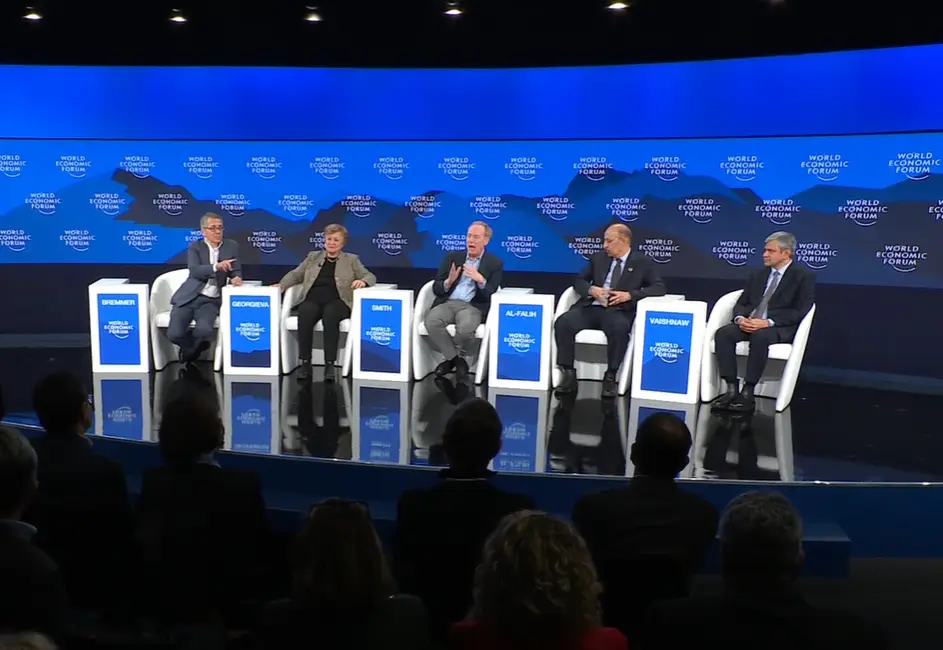
The capabilities and uptake of artificial intelligence have risen dramatically in recent years. But how are these opportunities playing out across economies such as India, Saudi Arabia and the global south? This question was at the centre of the panel “AI Power Play, No Referees” at the World Economic Forum in Davos.
“In every sphere of life and economy we are focusing on diffusion of AI in a focused way,” said Ashwini Vaishnaw, India’s Minister of Electronics and Information Technology, Information and Broadcasting. “AI is a multiplier of productivity.”
In Saudi Arabia, digital technology was identified long ago as a core element of the government’s Vision 2030 strategy. “We talked about access to data for research and drug discovery; open access to data was a pillar launched before covid,” said Khalid Al-Falih, Minister of Investment, Saudi Arabia.
“There are many use cases where we have deployed AI applications in health cases reducing disease by 80%; thousands of hours of physician time have been saved.”
Al-Falih also pointed to AI tools deployed in wind turbines that can detect incoming birds and adjust blade direction to avoid harm.
Large language models, which have rapidly become a mainstay of daily life and business, were – until the emergence of DeepSeek – largely US-based. Other countries are therefore keen to develop their own domestic technology ecosystems. “[We are] making sure that the IT industry, which is a very significant industry in our country, pivots in a very systematic way towards providing services to Indian companies as well as to the global companies,” said Vaishnaw.
“AI is going to be a key pillar of the global economy, globally traded,” said Al-Falih. As a result, the Saudi AI and Data Authority (SADAI) developed the first Arabic large language model, ALLaM, which is now owned by the national AI company Humain.
“The concern we have with AI is biases in the datasets models have been learning from,” said Al-Falih. “It’s important to build our own sovereign models and to make sure that unbiased data is fed and taught to the models so that they are fit for purpose for us. They need to be consistent with our values.”
Developing technological capacity worldwide is seen as essential not only for national governments, but also for multinational companies.
“The diffusion report that we released a couple of weeks ago estimated that today generative AI is used by 25% of the population in the global North, but only 14% in the global South, and the gap is getting wider,” said Brad Smith, Vice Chair and President of Microsoft.
Smith framed the issue through the lens of infrastructure and economic history. “What does this mean for the future of the world? I put it in the context of infrastructure and the history of infrastructure. Why is the world so divided economically? I’d say a large part of it is because during the entire colonial era, the colonial powers invested in building railroads in places like India and across Africa. They were important to move troops, to control territory, to extract minerals, but they never built power plants for the population.”
“Will AI exacerbate this divide or will it close it? It’s only going to close it if we embark on building infrastructure across the global South, then we need strategies that stimulate demand, that furnish supply. India, Saudi Arabia, they’re on the right track. It’s hard to look at Africa as a whole and be equally optimistic. And we need to think about that as well.”
International institutions will also have a crucial role to play. Kristalina Georgieva, Managing Director of the IMF, said: “I have a very deep conviction that a way we can help Africa is if we finally fulfil one commitment that was made that is not very expensive: $15 billion to get every African citizen, business, and state institution connected to the internet.”
Upskilling populations was highlighted as another key mechanism for spreading the benefits of AI.
“How people are prepared has to leave space to be ready for new skills,” said Georgieva. “In other words, learn to learn and adapt rather than learn specific technical skills and stop there. It is not an easy problem, and this is where we are telling governments that they have to invest much more thinking into helping communities, individuals, businesses. to be prepared for the world of AI because it is here. It’s no more a world of the future.”
Smith argued that investing in skills is also economically pragmatic. “It’s a lot cheaper for governments to invest in skilling than it is, frankly, to invest in data centres,” he said. “But if you invest in skilling, you start to stimulate demand for the private sector to invest in data centres.”
The panel was moderated by Ian Bremmer, President and Founder of the Eurasia Group.