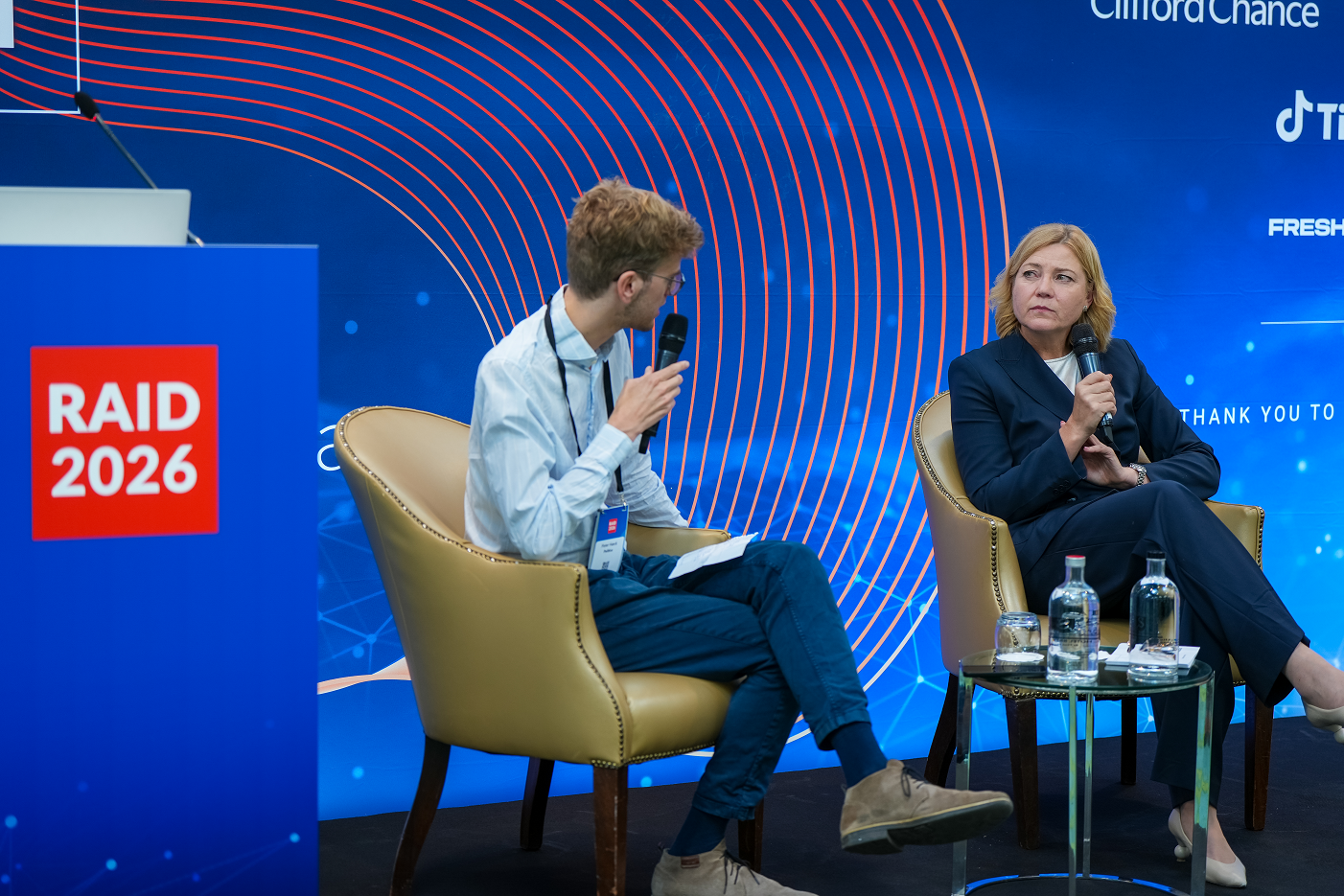
Two days of discussion at RAID 2026 brought together policymakers, regulators, industry, academics and civil society representatives to examine the challenges shaping the regulation and development of AI and the digital economy.
RAID 2026 brought more delegates than ever to Brussels on 28–29 September under the theme “Europe’s New Age of Innovation”.
The pace of change was brought sharply into focus by Henna Virkkunen, Executive Vice-President for Tech Sovereignty, Security and Democracy at the European Commission, in her keynote address.
“This summer we have seen AI agents act in ways we maybe never thought possible,” she said. “Our regulation is very well equipped to deal with these developments. We know that good regulation creates trust, generates predictability, and a level playing field that enables investments and adoption.”
In her opening speech, Eva Maydell MEP invited the audience to imagine “Mario”, who runs a family-owned European manufacturing company competing globally. “The technology will keep moving. Mario will adapt. Our competitors will adapt. Europe must be able to adapt too, because ultimately what we want is more super Marios out there and more super institutions.”
Emir Demircan, Senior Director Government Affairs EU at Siemens, highlighted an area of opportunity. “At Siemens, we call it industrial AI. And we European manufacturers think this is Europe’s main chance to be competitive in the AI race… In industrial AI, Europe still holds a competitive position. We have very strong manufacturing companies.”
Overlapping rules and a fragmented market remain among the barriers to growth that the EU is seeking to overcome.
Speaking on the panel on Growth and Simplification, Cecilia Alvarez, EMEA Data & Privacy Policy Director at Meta, called for a change of mindset. “We cannot be, as companies, regulators and policymakers, only looking at finding the problem. We should be also thinking about how we can make innovation possible. Look also at the solutions.”
For innovation to succeed, it must also be trusted. Lucilla Sioli, Director of the EU AI Office, said: “Trust means creating the conditions for which people and organizations can use AI without having to fear it. And this has been always the objective of the AI policy in the European Union, and it has also inspired the AI Act.”
Gary Davis, Senior Director, Regulatory Legal EMEA at Apple, said: “Trust is absolutely necessary for users to use AI in a way that will enrich their lives. We’ve invested heavily over many years in building trust for our users. We’ve distinguished ourselves from other companies in that we’ve sought not to collect data.”
Sovereignty was another recurring theme. Speaking on the panel on Capacity and Infrastructure, Tomas Jakimavicius, Director, European Government Affairs at Microsoft, emphasised technological interdependence: “Nothing works in isolation. We have vast value chains that are codependent on one another. So having the possibility to leverage a wider variety of offerings would only increase sovereignty, in that context of operational resilience.”
Speaking on the panel on Global Alignment, Lawrence Tallon, CEO, Medicines and Healthcare products Regulatory Agency (MHRA), UK, said: “It’s a very, very challenging moment for international cooperation… The whole conversation about AI is dominated by a hostile competition between the two global powers… and actually we need to find a way to harmonize globally.”
John Kavanagh, Privacy and Security, Public Policy Europe at TikTok, highlighted the growing role of privacy-enhancing technologies: “When sovereignty is getting discussed, we’re seeing privacy enhancing technologies get discussed a lot more… that’s something we should take some heart from.”
The practical challenges of compliance were explored by a panel moderated by Patrice Navarro, Partner at Clifford Chance. “We try to comply – everyone is doing its maximum – but at the end of the day we do it because there’s liability, there’s responsibility,” he said.
Moderating the closing panel on consumers and data, Dr Paul Voigt, Partner at Taylor Wessing, highlighted the EU’s growing focus on consumer protection online. “Over the last couple of years, a stronger focus has been put on online safety, with the Digital Services Act regulating online intermediaries such as online platforms, and with the upcoming Digital Fairness Act.”
Theresa Ehlen, lawyer at Freshfields, summed up the challenge of translating Europe’s strengths into growth: “We’ve got talent, capital and innovation, but what we’re lacking is the delivery and the predictability for companies to actually scale.”
RAID is set to return to Brussels on 27–28 September 2027. Pre-register here.