The 2026 Masters of Digital conference in Brussels arrived at a pivotal moment for Europe. With the US and China racing ahead in AI, quantum computing and digital infrastructure, the continent finds itself at a make-or-break juncture. Can Europe translate its innovation into global leadership, or will it remain a hotbed of startups without scale
Policymakers, defence leaders, tech executives, and investors grappled with the three defining challenges of Europe’s digital decade: scaling its industries, securing its future, and simplifying its rules. From Ukraine’s battlefield – driven tech revolution to the EU’s regulatory overhauls, from cybersecurity’s invisible wars to the transatlantic tensions reshaping global markets, one question loomed largest: does Europe have what it takes to compete?
In this series of articles, RAID explores the key concerns of the conference: scale; AI competitiveness; regulation; cybersecurity; defence digitalisation; capital investment; transatlantic tension; and energy.
The scale challenge
The numbers tell a familiar story: Europe has 600 unicorns, 28 of them born in 2025 alone. Yet not a single trillion-dollar company calls the continent home. At the Masters of Digital conference in Brussels, this gap wasn’t just lamented – it was dissected as a failure of scale, not innovation.
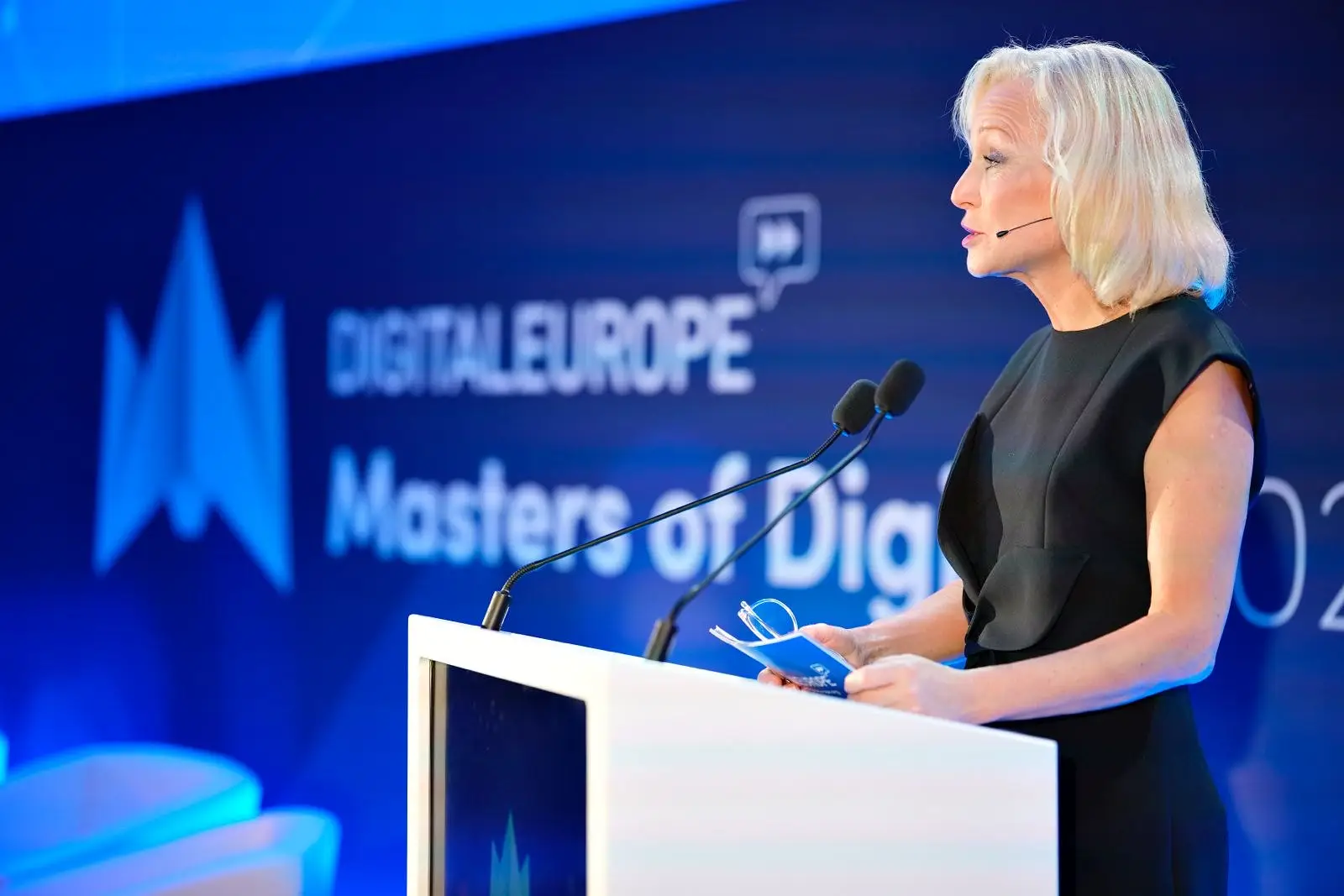
Cecilia Bonefeld-Dahl, Director General of Digital Europe, set the tone in her opening remarks. “Europe doesn’t have an innovation problem,” she declared, “it has a scale problem.” The contrast with the US, where a handful of tech giants dominate global markets, was impossible to ignore.
Her call to action was direct: “We need to stop talking about regulation.” Yet even as she criticised red tape, she welcomed the EU’s recent drive for simplification – a sign, perhaps, that the bloc is beginning to hear its industry’s pleas. “We have 10 omnibuses. Some could have gone a lot further.”
The cost of compliance, she noted, citing Mario Draghi’s estimate of €200 billion, is money “we could spend more wisely.”

For Henna Virkkunen, Executive Vice-President for Technological Sovereignty, Security and Democracy at the European Commission, the solution lies in unlocking capital. “We have around €33 trillion in household savings,” she said, “much of which is not mobilised for innovation.” The Commission’s answer? A savings and investment union to channel private funds into startups. “Our goal is to make Europe the easiest place in the world to grow a tech company from startup to unicorn.”
Eva Maydell MEP argued that Europe’s sovereignty depends on scaling up its tech sector. “If we’re able to grow our unicorns further, free up capital, and strengthen our national champions, then we are going to have our own sovereignty.” Her message was clear: Europe must stop exporting its best ideas and nurture its own giants.
Andre Rogaczewski, CEO of Netcompany, drove the point home. “We have to look at ourselves: too old, too conservative,” he said. ““I’ve never seen the EU work faster than now, but we need to work faster.”
AI’s make-or – break moment: can Europe compete?
If scale is Europe’s Achilles’ heel, AI is its battleground. The continent’s approach to AI regulation – once hailed as a global standard – was under scrutiny at Masters of Digital conference.
Jeff Campbell, Cisco’s Chief Government Strategy Officer, didn’t mince words. “The AI Act is fairly well thought out,” he admitted, “but it’s not the subject – it’s the messaging. It sends a signal to the market that pushes investment offshore.”
Yet for all the criticism, there were signs of progress. Roberto Viola, Director General of the European Commission’s DG CNECT, highlighted the bloc’s gigafactory push – the largest infrastructure project in European history. “We are investing billions,” he said. “But is it enough? Doubling it might be a good idea.”
The number of companies emerging in Europe shows promise. “We are here to serve European sovereignty,” said Valérian Giesz, cofounder of quantum computing startup Quandela, after accepting the Future Unicorn Award. “This recognition obliges us to ‘make it.’ It’s time to wake up the quantum giant.”
But sovereignty isn’t about isolation. “Do we want to kick out everyone who is not European? That would not be good. We have an allied stack,” said Cecilia Bonefeld-Dahl, Director General of Digital Europe.
“Sovereignty is not a binary choice,” said Mauro Macchi, CEO for EMEA, Accenture. “Companies need to be able to find the right level of competitiveness anywhere in the world.”
Europe’s AI ambitions also hinge on connectivity and collaboration. “We need to think about how to maximise value – not just as a commercial framework, but as a foundation of trust,” said Pasi Toivanen, SVP, Strategic Government & Industry Initiatives at Nokia.
Regulatory overhaul: simplifying to compete
Europe’s regulatory landscape – often criticised as a labyrinth of overlapping rules – was a recurring theme of Masters of Digital conference, which expressed both frustration and cautious optimism about the EU’s efforts to streamline regulations.
The Digital Omnibus – a package of reforms aimed at reducing bureaucratic burdens – is frequently cited as a step in the right direction. “We are taking concrete steps to remove distractions and barriers,” Henna Virkkunen said. “We’ve already taken many steps with several omnibuses. We’re also deepening the single market.”
Yet challenges remain. “The internal market is fragmented,” Nadia Calviño, President of the European Investment Bank admitted. “In the US, you know you’re dealing with one market. In Europe, we’re still working on it.”
Audrey Scozzaro Ferrazzini, Vice – President of Government Affairs at Qualcomm, reinforced this point. “The first thing we’d like to see in Europe is scale,” she said. “But what’s more important is avoiding fragmentation. That’s what we need in Europe – and acceleration.” With 6G on the horizon, she noted, the continent can’t afford to move at its usual pace.
“B2B data sharing in the Data Act is the worst idea we ever had,” said Cecilia Bonefeld-Dahl, Director General of Digital Europe, referring to the proposal for companies to share data. “Let’s make sure sectors are governed by one regulatory framework, not eight or ten.”
Her plea for simplification was echoed by Pilar del Castillo Vera MEP. “Simplification is the mantra of this legislative term,” she said. “But it must become a reality.”
Liisa-Ly Pakosta, Estonia’s Minister of Justice and Digital Affairs, offered a pragmatic counterpoint. “Good and clear rules are the basis for innovation,” she said. “Development always includes risks, and risks mean things can go wrong.”
She distinguished Estonia from countries banning social media for children. “We believe young people are members of digital society – and we are not planning to ban anything.” Estonia’s approach, she noted, is to test in real situations and sandboxes, and not stifle experimentation.

Vice President of European Government Affairs, Microsoft. Photo: Masters of Digital
Cybersecurity: Europe’s invisible war
Masters of Digital conference had several wake-up calls, but few more alarming than this: Europe is not prepared for the cyber battles of the 21st century.
Despina Spanou, Deputy Director – General of DG CNECT, framed the threat in stark terms. “The risk of fragmentation is a threat to the EU,” she said. “One weakness is everyone’s weakness.” Her warning extended beyond national borders: “We’re known as champions of rules. But it’s not about championing regulation – it’s about upping our security game.”
Juhan Lepassaar, Executive Director of ENISA, was even more direct. “We are on the brink of the storm and we are not prepared to deal with it,” he said.
Alongside geopolitical tensions, Europe is also bracing for the quantum era. “It’s not rocket science,” he said. “It’s the same risk management approach. What we need is time and resources. Start now so we’re ready for 2030.”
Jeffrey Apeldoorn, VP of Missions at ICEYE, highlighted the space dimension of cybersecurity. “Space capabilities are increasing, but so is fragmentation. The key is a federated system. We should treat satellites as core critical infrastructure.”
Jean-Charles Ellermann-Kingombe, NATO’s Assistant Secretary General for Cyber and Digital Transformation, said, “Industry sits on piles of data and owns the critical infrastructure, so we need them round the table.”
Karianne Tung, Norway’s Minister of Digitalisation, shared a cautionary tale from her own country’s government. “We had an attack and couldn’t access email or calendars,” she said. “We learned tough lessons. We need to get better at rehearsing for cyberattacks.”
Her call for public-private collaboration was echoed by Nanna-Louise Linde, Vice President of European Government Affairs, Microsoft. “85% of digital infrastructure is in the private sector, so we need to work together” she said.
Defence and digitalisation: Europe’s hybrid frontline
Ukraine’s war has exposed a fundamental shift in modern conflict: the fusion of digital and kinetic warfare. At Masters of Digital, defence and tech leaders warned that Europe’s lack of preparedness for hybrid threats could have catastrophic consequences.
Valeriya Ionan, Advisor to Ukraine’s Minister of Defence, set the stage. “When the invasion happened, we had only seven local drone producers. Now we have 550.” Ukraine’s rapid adaptation – from digital passports to the Brave1 platform for defence innovators – has turned it into a real-world lab for rapid development and deployment of military tech.
But, as Cecilia Bonefeld-Dahl warned, “Ukraine is prepared. Europe is not.” General Seán Clancy, Chair of the European Military Committee, reinforced this urgency. “We need to have a faster mechanism,” he said.
Viktoriia Yaremchuk, CEO of Farsight Vision, offered a ground-level perspective from Ukraine. “Digital twins for battlefield data are critical,” she said. “Competition is needed, but it’s also hindering – companies end up working on the same things.”
Her plea for better coordination resonated with Henrik Bliddal, Head of National Security and Defense, Geopolitical & Government Relations at Nokia. “We’re swimming in sensors and drowning in data, but we don’t have the insights” he said. “We need trusted networks – and we need to be bold.”
LtGen Michael Vetter, Director – General for Innovation and Cyber at Germany’s Federal Ministry of Defence, highlighted the role of tech in military might. “Software-defined defence is the future,” he said. “We need to mandatorily advise industries to work on open source architecture.”
He invoked General Patton’s WWII leadership maxim: “Lead, follow, join – or get out of my way.”
The money problem: why Europe’s capital isn’t working
Europe has no shortage of capital – €33 trillion in household savings, as Henna Virkkunen, the European Commission’s Executive Vice-President for Technological Sovereignty, Security and Democracy told Masters of Digital conference – but too little of it flows into innovation.
Nadia Calviño, President of the European Investment Bank, framed the challenge. “The number of startups in the EU is comparable to the US,” she said. “The talent is there. We need to nurture it and scale it up.” Yet Europe’s financial ecosystem remains risk-averse and fragmented. “Investors want high returns with no risk,” she observed. “Can we make these impossible ends meet?”
For Mauro Macchi, EMEA CEO of Accenture, the problem isn’t just money – it’s adoption at all levels. “Large players in the EU are adopting AI at the same pace as US competitors,” he said. “It’s the SMEs who are behind.” The financial implications, he warned, are crippling smaller firms. “Many CEOs tell me their workforce isn’t moving at the same speed as tech,” he added.
Victor Negrescu MEP, Vice President of the European Parliament, underscored the stakes. “It’s not enough to speak about AI’s impact on daily life – we need to focus on companies,” he said. “AI and cybersecurity are crucial for agriculture, education, health, defence.”
And the level of investment is seriously lagging. “The EU is not competitive enough,” he said. “The amount Europe is investing is AI is not sufficient for even Germany.”
The European Investment Bank is trying to bridge the gap. “We’re a catalyser,” Calviño said. “We never invest alone – we work in partnership with private banks.” The EIB is working on an exit toolbox, pre-IPO support and acquisitions, she said. She also called for the possibility of consolidating European stock markets to promote competitiveness.
Peter Kyle, the UK’s Secretary for Business and Trade, offered a transatlantic perspective. “Why is it that Europe has no trillion-dollar companies?” he asked. “We seem to be stuck. We’re not good enough at coordinating the constituent parts.” His answer? Reform pension funds, create growth zones, and “stop protecting the past from the future”.
Transatlantic tensions: collaboration or competition?
Against the backdrop of rising geopolitical tensions, the Master of Digital conference grappled with a fundamental question: can Europe and the US still work together?
Peter Kyle, the UK’s Secretary for Business and Trade, was unequivocal. “Resilience should be tackled together, not through protectionism,” he said. “Our economies are totally integrated – Airbus manufactures wings and satellites in the UK. It makes sense to reinforce this, not diminish it.”
Yet the shadow of Trump’s tariffs and China’s state-driven model loomed large. “The challenge is to spot where the innovation is,” Kyle said. “It’s no longer happening primarily inside the state.”
American firms represented at the company are keen to work in partnership with Europe. Hendrik Bourgeois, Mastercard’s SVP of Government Affairs, struck a pragmatic tone. “Geopolitical tensions have increased,” he said. “But the framework hasn’t changed all that much. Any transatlantic firm needs to deliver for its stakeholders.”
Claudia Herben, Johnson & Johnson’s Global Head of MedTech, was optimistic. “Innovation has to work for all of us,” she said. “We need to strengthen collaboration between the US and EU – imagine what we can achieve.”
Nanna-Louise Linde, Vice President of European Government Affairs, Microsoft criticised protectionist measures in Europe such as the incoming “Buy European” public procurement initiative.
“Don’t make rules that make it hard to help when we want to help,” she said. “We need collaboration and need to prepare in peacetime for when a crisis hits us.”
Meanwhile, European companies are struggling to compete in a more heavily regulated environment. As Cecilia Bonefeld-Dahl, Director General of Digital Europe put it: “Industries don’t have a problem. Governments do.”

How can Europe power its digital future?
Europe’s digital ambitions are inextricably linked to its energy transition. Speaking at Masters of Digital, Dan Jørgensen, the EU’s Commissioner for Energy and Housing, framed the challenge as an opportunity. “We can turn this time of urgent necessity into a time of invention,” he said, referring to the need for green energy to power data centres and gigafactories.
Alexandros Paterakis, Deputy CEO of Greece’s PPC Group, was more direct. “We’ve seen the Commission and industry moving in the right direction,” he said. “But we need to take a leap of faith, take risks and get projects done.”
“We need to make the future grid intelligent,” said Peter Weckesser, Chief Digital Officer of Schneider Electric.
“Grids are a price driver and a bottleneck,” said Sabine Erlinghagen, CEO of Siemens’ Grid Software. “We are leading in digitalisation in Europe. We have world leading utilities as well as powerhouses on the vendor side.”